


VIX Term Structure for Day Traders: When Volatility Is Fuel, Not Noise
- May 2
- 2 min read
Updated: 23 hours ago
TL;DR — VIX term structure tells us whether volatility is fuel, friction, or a trap. When VIX3M sits above VIX (contango), the market is pricing calm — observed on 94% of sessions 2022–2026. When VIX3M sits below VIX (backwardation), the market is pricing immediate stress — observed on the remaining 6%. The trading rules change in each regime: contango supports trend-continuation setups; backwardation favors mean-reversion and tighter risk. Treating the two regimes the same is the cleanest way to consistently misjudge intraday positioning.
VIX is a single number; VIX term structure is a curve. The relationship between short-dated implied volatility (VIX, 30-day) and longer-dated (VIX3M, 91-day) tells us whether the market expects the current state to persist or change. The curve's slope is the signal.
Contango vs backwardation — what the long-horizon data shows
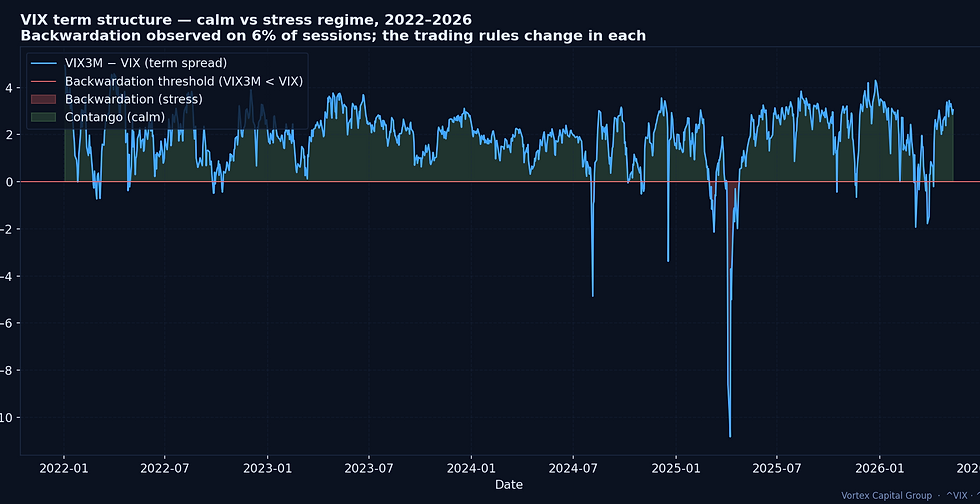
The chart shows the daily VIX3M − VIX spread since 2022:
Contango (positive spread, green): 94% of sessions. Market is pricing more risk further out than near-term. The default state. Trend-continuation setups work here; ORB follow-through is more reliable; VIX-Adjusted Opening Range sizing can stay near baseline.
Backwardation (negative spread, red): 6% of sessions. Market is pricing immediate stress higher than longer-term risk. This is the regime that broke during 2022 inflation prints, 2023 banking stress, and various 2025-2026 macro events. Trend setups fail more often; mean-reversion outperforms; position sizes should shrink.
Why the regime change matters intraday
Backwardation regimes carry three execution implications that compound:
Range expansion is asymmetric. VIX-implied exhaustion walls (see VIX exhaustion walls study) stop working in stressed regimes — realized range often exceeds implied.
Spreads widen and quote stability degrades. Risk-off routing logic kicks in. See Risk-Off Routing study.
Trend setups become reversal traps. What looks like a clean breakout in calm tape acts as exhaustion in stressed tape. The data is consistent across our opening range studies and ORB framework.
How to use the term structure on the desk
Before the open: check the prior-day VIX3M − VIX close. If positive, default trading rules apply. If negative, default to smaller size, tighter confirmation thresholds, and skepticism of trend-continuation setups. The check takes 30 seconds and changes the entire day's trading discipline.
Related
Joining the desk
Traders who already check term structure before sizing are running the regime-detection discipline this post describes. The trader application takes about ten minutes.


Comments