


Sterling Trader Pro DMA Workflow: Hot Keys, Routes, Locates, and Risk in One Session
- 2 days ago
- 4 min read
TL;DR — Sterling Trader Pro earns its value during the windows where tape speed is highest — open and close. NVDA's median absolute 1-minute move at 09:30–09:45 ET is 9.8 bp; at 12:30–13:00 it's 3.2 bp. The hotkey workflow isn't decoration; it's the only viable execution path during the windows where decisions need to land in under 5 seconds. The retail order ticket asks side + size. The desk platform asks route, queue, urgency, slippage tolerance, and stop logic — and asks them fast enough to matter.
The difference between a retail order ticket and a professional DMA workflow shows up when the tape accelerates. A retail platform asks what side and what quantity. A desk platform asks a deeper question: what route, what limit logic, what queue assumption, what slippage tolerance, what cancel condition, what stop, and what happens if the trader needs to flip from passive to aggressive in two seconds.
Sterling Trader Pro becomes valuable when it turns trader intent into controlled execution. Hotkeys aren't for impulsive clicking. Routes aren't decorative. Level 2 isn't a screen to stare at. The platform matters when each part of the surface — order entry, route choice, hot-key risk, position visibility — supports a defined process under speed.
Where the speed actually matters — tape data
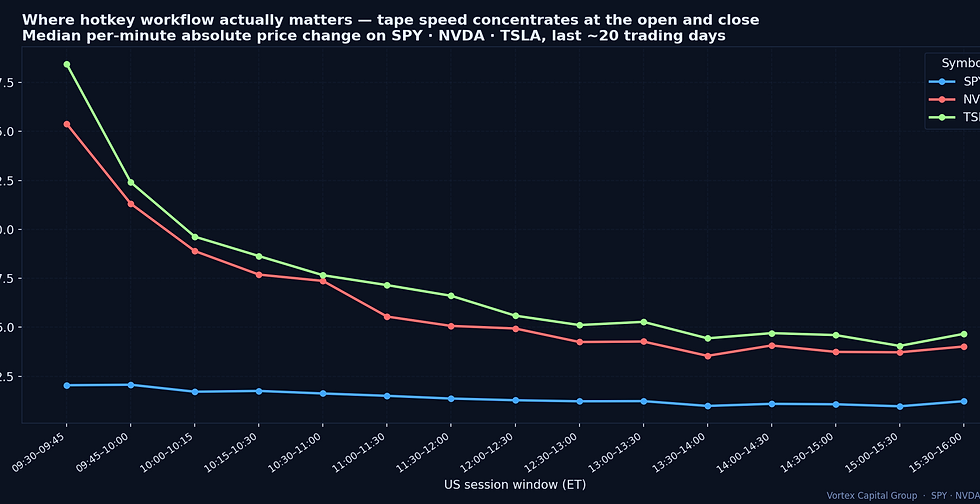
The chart above measures "tape speed" — the median absolute per-minute price change in bp of session open — across SPY, NVDA and TSLA by 15-minute window. Three observations show exactly where hotkey workflow earns its keep:
NVDA at 09:30–09:45: 9.8 bp per minute. At a $130 share, that's about $0.13 of decision-relevant price movement every 60 seconds. A trader using a retail order ticket — pull down the symbol, type quantity, choose side, review, submit — easily burns 8–12 seconds. By the time the order arrives, 1.5 bp of edge is gone. Across 200 trades a year, that's hundreds of basis points.
TSLA at 09:30–09:45: 8.4 bp per minute. Similar tape, similar problem.
Lunch window (12:30–13:00): 3.2 bp on NVDA, 1.9 bp on SPY. The window where hotkey speed matters least — the tape isn't moving fast enough to make a 5-second delay material.
Sterling Trader Pro's hotkey surface compresses the open/close decision-to-fill latency from 8–12 seconds to roughly 1–2. On the tapes where bp-per-minute concentrates, that's where the workflow pays for itself. Routing through a slower interface during these windows is structural P&L leakage. We covered the per-symbol cost surface in our DMA vs Retail Broker piece.
The workflow we care about
Route selection should match urgency, information leakage, spread width, and liquidity fragmentation.
Hotkeys should reduce decision latency without bypassing predefined risk discipline.
Locate status and borrow rate need to be part of the setup before a short order is staged. We covered locate workflow in detail in our HTB mechanics piece.
Level 2 should inform queue position, spoof risk, refresh quality, and whether passive entry is realistic.
Hotkeys are a risk tool when designed correctly
A hotkey setup shouldn't encourage random speed. It should encode planned behaviour. One key may join a bid with a defined size and limit offset. Another may exit half. Another may cancel all. Another may route aggressively only when the setup demands urgency. The point isn't to remove the trader's thinking; it's to remove the seconds where thinking has already been done but execution hasn't caught up.
This is where platform setup becomes part of risk management. A trader who changes order size, route, and stop logic under stress isn't using speed — they're using panic. A trader who enters the session with predefined route families, size buckets, and slippage tolerances is using Sterling Pro as the desk-grade layer it was designed to be.
Routes, locates, and Level 2 belong in the same conversation
A short setup isn't ready just because the chart rolls over. The trader needs locate confirmation, borrow-rate awareness, and a route plan that fits the available liquidity. If Level 2 shows thin depth and the name is hard to borrow, a late market order is structurally wrong. The setup might be valid, but the order style doesn't fit. We covered when to use smart routing vs override manually in our smart vs manual routes piece, and the venue-by-venue ATS picture in the dark-pool liquidity study.
For long momentum trades, Level 2 and Vortex Flow help decide whether the trader should seek liquidity or provide it. If CVD is expanding and the window is short, urgency may be justified. If the book is absorbing and the spread is wide, patience earns the better fill. The opening range follow-through study quantifies which symbols and regimes carry continuation worth chasing.
Why this matters to our desk
Sterling Trader Pro gives our traders the execution surface that matches our infrastructure: DMA routes, Level 1 and Level 2 data, baskets, multi-account workflow, hotkeys, and risk controls. We pair that with Vortex Flow for order-flow context, Vortex Edge for volatility ranking, four-vendor HTB access for short-side reliability, and multi-clearing redundancy.
Related
DMA vs Retail Broker Execution (canonical) · Smart Routes vs Manual Routes · Dark Pool Liquidity · Hard-to-Borrow Mechanics · 09:30 ORB study.
Joining the desk
The right applicant doesn't need us to explain why a platform matters. They want to know whether our platform can keep up with their process. That's the conversation we want in the trader application — what you trade, how you route, how you size, and what your hotkey workflow looks like.


Comments