


Smart Routes vs Manual Routes: When the Trader Should Override the Router
- a few seconds ago
- 4 min read
Updated: 2 days ago
TL;DR — Smart order routing isn't the enemy. Blind routing is. On SPY in 2026, the first 15 minutes of cash session carry 251K shares per minute of average volume with a 4.92 bp per-minute range, and the final 30 minutes carry 277K shares per minute. The lunch window carries 57K–80K with a 2.2 bp range. Same security, different routing problem. We let the smart router work in liquid windows where balanced fragmented-liquidity access is the goal, and we override manually when the trade has a specific urgency, queue, footprint or information-leakage problem the router can't see.
A good smart router protects traders from fragmented liquidity by checking venues, price, fill probability, and sometimes hidden liquidity. But there are moments when the trader knows something the router doesn't: the setup has a short time window, the queue position matters, the level is sensitive, or footprint will telegraph intent before the move develops. Smart routes are useful right up to the point where they aren't.
The first mistake is treating smart routing as automatically intelligent. The second is treating manual routing as automatically superior. Both are tools. A smart route can be exactly right when the trader wants balanced liquidity access across a fragmented book. A manual route can be exactly wrong if the trader cannot articulate the specific reason it's needed.
What the intraday volume and range profile tells us about route choice
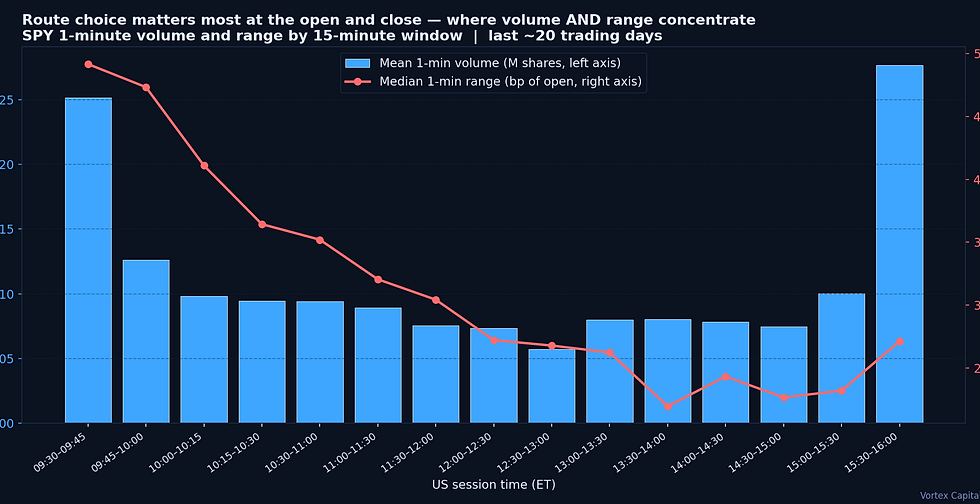
The chart above shows the U-shape every active trader feels but few quantify. SPY 1-minute volume averages 251K shares at 09:30–09:45 and 277K at 15:30–16:00. The midday low (12:30–13:00) drops to 57K. Range follows a similar but distinct curve: 4.92 bp per minute at 09:30–09:45, 2.71 bp at the close, 2.2 bp at the lunch low. Volume and range concentrate together at the open and at the close — and that's exactly where route choice matters most.
09:30–09:45: high volume, high range. Information density is at its peak. Manual routing matters because the spread is wide, queue position decays quickly, and information leakage from a single visible order can move the level. ISO, hidden, and peg-to-mid orders carry their largest edge here.
10:00–14:30: moderate volume, declining range. The window where smart routers shine. Liquidity is fragmented across lit and dark, the urgency is lower, and the router's job (balanced access without picking a venue prematurely) aligns with the trade's needs.
15:30–16:00: highest volume, moderate range. Closing auction mechanics dominate. Manual routing matters because MOC/LOC orders, on-close imbalance announcements, and closing cross participation each demand explicit decisions a smart router can't make on its own.
When we let the smart router work
We lean on smart routing when liquidity is fragmented, the trade is not hypersensitive to milliseconds, and the objective is broad participation without making a single-venue bet. That covers liquid large caps, ETF-linked names, and stocks where lit books, ATS liquidity, and dark interaction collectively form a reasonable composite. The router's job here is exactly what it's good at: probability-weighted venue selection.
Even when we use a smart route, we define guardrails. What's the maximum acceptable price? How long can the order rest? Is partial fill acceptable? Does the trade require completion or only participation? If the trader can't answer those questions, the problem isn't the router — it's the trade plan.
When we override manually
Opening impulse: lit urgency matters more than midpoint improvement when seconds decide the trade. We covered the auction-window dynamics in our 09:30 ORB study.
Absorption level: passive queue position matters more than immediate fill when invalidation is tight. Smart routers optimize for price + completion; absorption trades optimize for queue, which the router treats as a side effect.
Sensitive short: dark-pool or midpoint interaction can reduce footprint before the move confirms — if time permits. A visible short in a thinly-traded HTB name walks the borrow desk against you. Our dark-pool liquidity piece covers the venue-by-venue math.
Thin liquidity: manual limits prevent a marketable order from paying through an unstable book. The lunch low (57K shares per minute on SPY, far less on single names) is when this matters most — even a moderate retail order can move the level.
The review question after every routed order
The post-trade review is simple but demanding: did the route match the order state? If the trade needed urgency, did we define slippage and act? If the trade needed patience, did we avoid crossing unnecessarily? If the trade needed footprint reduction, did dark-aware logic improve the fill or did we surrender execution to a router that didn't know our intent?
On the desk, every loss gets reviewed against three filters: was the directional read right, was the size right, and was the route right. The third filter catches the most common failure mode that traders never journal — a correct trade routed badly. Route review isn't an extra step. It's the step that separates traders who improve from traders who only get lucky.
Related reading
Dark-pool liquidity decisions · DMA vs retail broker execution · the 09:30 ORB study · the 9:45 dead zone.
How we run it
Sterling Trader Pro gives our desk the route-control surface to make these choices quickly. Vortex Flow gives the order-flow evidence — CVD, VWAP, heatmap liquidity, price-ladder behaviour — to know when manual override is warranted. DMA is valuable because it lets a trader match order behaviour to market condition instead of inheriting the average choice. Applicants who can explain their route decisions before the order is sent and after the fill is reviewed get our attention fastest. The trader application takes about ten minutes.


Comments