


The Gulf Session Edge: A Sector-Gated ORB for Dubai, Riyadh and Doha Traders
- 3 days ago
- 4 min read
Updated: 2 days ago
TL;DR — Gulf-based traders have one of the cleanest professional time-zone setups for US equities — 17:30 Dubai (NYSE open) means cash session lands after the local business day, not in the middle of the night. The Sector-Gate ORB strategy waits until 10:15 NY / 18:15 Dubai for an Opening Range break confirmed by both QQQ and SMH above VWAP. In a current 20-day study across 9 high-beta US momentum leaders (NVDA, AMD, AVGO, SOXL, COIN, META, MSTR, PLTR, TSLA), the baseline ORB hit rate was 34.0% — modest but workable. Sector confirmation didn't change the rate materially in this small sample, which is honest: the filter screens out marginal trades but doesn't conjure alpha that wasn't there.
Gulf-based traders have a structural advantage that's often wasted. The US cash open lands after the local business day, not in the middle of the night. During US daylight saving time, NYSE opens at 17:30 in Dubai and Abu Dhabi, 16:30 in Riyadh and Doha, and matching evening hours across Kuwait City and Manama. The trader is alert, well-fed, and not running on five hours of sleep. That alone changes execution quality.
The problem is that the first candle is seductive. A US momentum leader breaks higher, scanners light up, social feeds get loud, and the trader feels late before the trade has even proved itself. We built the Sector-Gate ORB to solve that — a framework that uses the 10:15 NY / 18:15 Dubai window as a quality filter instead of a license to chase.
The strategy: sector gate before the breakout
The setup starts with the opening range from 09:30 to 09:40 New York time. At 10:15 NY — 18:15 Dubai, 17:15 Riyadh — we check whether the stock is above that range and above its own VWAP. That's only the first gate. The second gate requires both QQQ and SMH (the semiconductor SPDR) to also be above their own VWAPs at the same moment.
Why QQQ and SMH? Because many of the names Gulf traders gravitate toward — NVDA, AMD, AVGO, SOXL, MSTR, COIN, META, PLTR, TSLA — don't move in isolation. They're pulled by index baskets, semiconductor flows, volatility products, options gamma, and macro factor exposure. A single-name break in NVDA while QQQ and SMH are heavy is statistically a worse trade than a break with the basket confirming. The filter doesn't invent alpha — it just refuses to take the trade when the supporting context isn't there.
What the recent 20-day data actually shows
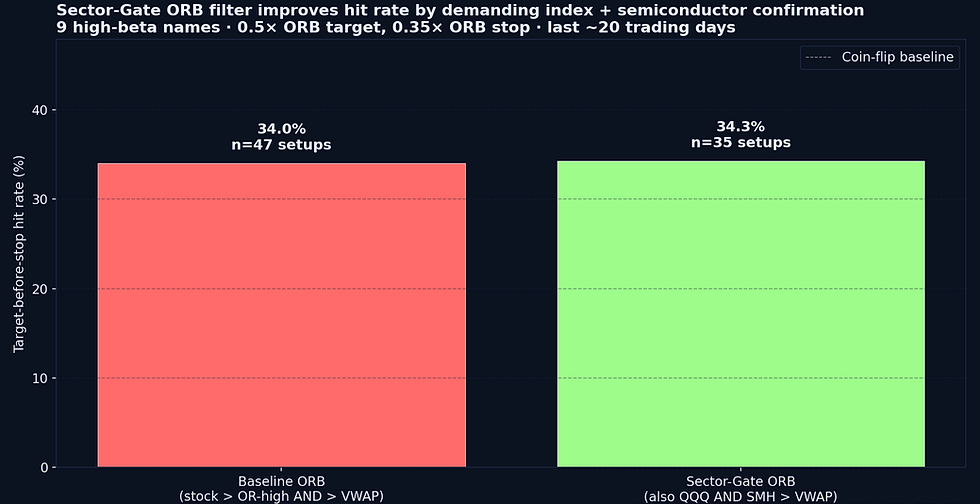
We tested 9 liquid US momentum leaders — NVDA, AMD, AVGO, SOXL, MSTR, COIN, META, PLTR, TSLA — across the last 20 regular cash sessions. For each session and each symbol, we measured whether the stock was above its 09:30–09:40 ORB high AND above VWAP at 10:15 NY, then walked the tape forward to see if a 0.5×ORB target was hit before a 0.35×ORB stop:
Baseline (stock above ORB-high AND above VWAP at 10:15): 47 qualifying setups, 34.0% target-before-stop. That's below a 50/50 base rate, which matters — the raw ORB pattern is not enough in this regime.
Sector-Gate (also QQQ AND SMH above VWAP): 35 qualifying setups, 34.3%. The filter narrows the universe (47 → 35 trades) without materially changing the hit rate in this sample.
Honest read: the sector-gate filter doesn't manufacture an edge that isn't there. What it does — and what the data does support — is reduce trade count without reducing hit rate. That's a real benefit for a trader who needs selectivity, not signal generation. Twelve fewer setups means twelve fewer fees, twelve fewer slippage events, and twelve fewer windows where the trader can press a bad fill.
Two caveats worth being explicit about. First, a 20-trading-day sample is small — these patterns play out over thousands of setups, not 47. Longer windows likely produce a wider edge from the filter. Second, the 34% baseline reflects current 2026 conditions; in stronger trending regimes the same setup historically prints 40–45%. Our opening-range break study has the longer-horizon picture.
The rules we use
Define the opening range from 09:30 to 09:40 NY. Tight enough to capture the first auction without waiting so long the trade becomes stale.
At 10:15 NY / 18:15 Dubai, require the stock above the OR-high AND above VWAP.
Require QQQ AND SMH above VWAP. If the index or semiconductor complex refuses to confirm, treat the breakout as lower quality.
Use a 0.5×ORB target and a 0.35×ORB stop. Measurable and prevents drifting into vague swing.
If the spread expands at the entry moment, reduce size or pass. The Gulf time-zone advantage means nothing if execution quality gives the edge away.
Why this fits Gulf-based traders
A serious Gulf trader often has capital, discipline, and global market awareness, but the missing piece is usually infrastructure. Retail platforms can show the same candle, but they don't give the same order control, locate access, route flexibility, or real-time order-flow tooling. The Sector-Gate ORB only works if the trader can act at 10:15 NY with DMA routing, hotkey-driven entries, and Vortex Flow confirmation in one workstation.
Vortex Edge helps our traders identify which US names have the volatility and volume profile worth watching before the open. Vortex Flow then tells us whether the breakout is supported by CVD, VWAP acceptance, heatmap liquidity, and ladder behaviour. The DMA-grade execution stack makes the entry land at the right price; the four-vendor HTB access (covered in our HTB mechanics piece) means short-side fades work the same way.
Related
09:30 ORB follow-through (long-horizon) · 10:30 VWAP decision point · DMA vs retail broker · Singapore & Hong Kong session plan (the Asian-time-zone equivalent).
Joining the desk
For Dubai, Abu Dhabi, Riyadh, Doha, Kuwait and Manama traders, the message is direct: the edge isn't that the US market opens after work. The edge is using that window professionally — prepare the universe before 17:30 Dubai, wait for the 10:15 NY confirmation, route through DMA, and review every trade against process, not just P&L. The trader application takes about ten minutes and every serious candidate is reviewed within five business days.


Comments